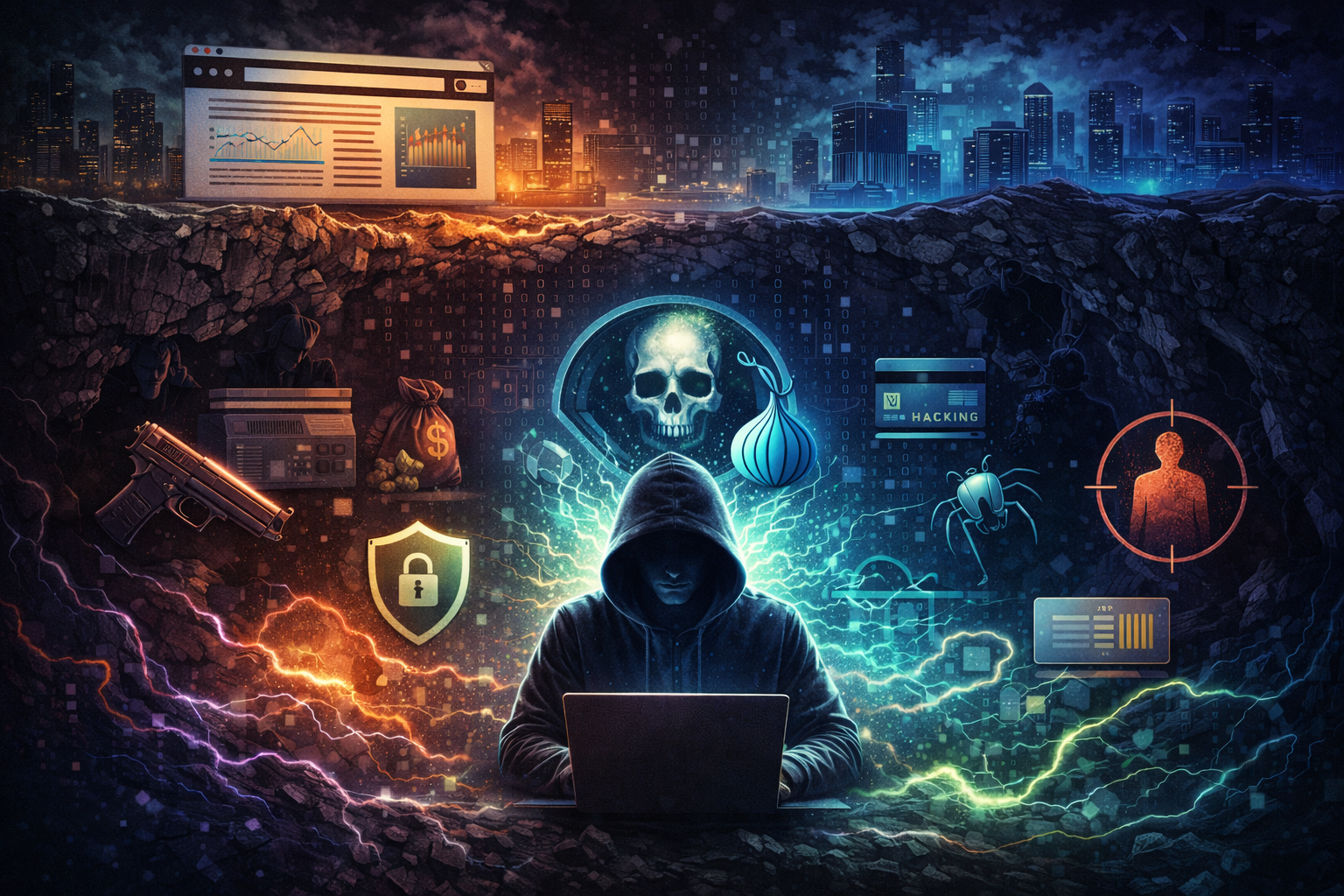
Few corners of the internet are more misunderstood than the dark web. The term conjures images of criminal marketplaces and shadowy actors — and while those elements exist, they represent only a fraction of what actually happens in these networks. The dark web contains both lawful and unlawful content, and understanding the difference matters for anyone thinking seriously about privacy and internet freedom.
How Does the Dark Web Work?
The internet is often described in layers. The surface web is what you find through search engines — indexed, publicly accessible pages. The deep web refers to content that isn't indexed: private databases, email inboxes, banking portals. The dark web is a specific subset of the deep web that requires specialized software to access and is deliberately designed for anonymity.
Encrypted overlay networks like Tor and I2P route traffic through multiple nodes, obscuring the origin and destination of communications. No single node in the chain knows both who you are and what you're accessing. This architecture is what enables the privacy properties that make the dark web valuable for legitimate purposes.
Legitimate Uses: Privacy, Journalism, and Whistleblowing
The same anonymity that can shield criminals from detection also protects those who genuinely need privacy:
- Journalists use dark web communication channels to interact with sources in dangerous environments where email or phone contact would put people at risk
- Whistleblowers rely on anonymous submission systems (like SecureDrop) to share documents with news organizations without exposing their identity
- Activists in authoritarian countries use these networks to communicate and organize without fear of government surveillance
- Ordinary users seeking privacy from commercial tracking use these tools to browse without building a data profile
Accessing Restricted Content
In countries where access to information is heavily restricted, the dark web provides a path to the open internet. Users who would otherwise be cut off from international news, academic resources, or uncensored communication platforms use these tools to bypass government filtering.
This use case is particularly important for understanding why anonymizing networks exist in the first place. They weren't designed for criminal activity — they were designed for free expression in environments where free expression is suppressed.
The Criminal Reality
It would be dishonest to ignore the criminal activity that takes place in these spaces. The same anonymity that protects journalists also provides cover for illegal marketplaces, stolen data trading, and other harmful activities. This is real, and it creates genuine harm.
Law enforcement agencies around the world actively investigate dark web criminal activity, and many high-profile cases have resulted in successful prosecutions. The anonymity of these networks is strong, but not absolute — poor operational security by bad actors has led to many arrests.
Tor and I2P: Two Different Approaches
The two primary tools for accessing anonymizing networks take different approaches:
- Tor is primarily designed for anonymous access to the regular internet, with .onion hidden services as a secondary capability. Traffic exits through volunteer-operated exit nodes to reach the open web.
- I2P is a fully internal network — designed for communication and file sharing entirely within the I2P ecosystem. It emphasizes secure peer-to-peer communication and hosting services that exist only within the network.
Both networks are legitimate tools maintained by communities committed to privacy and free expression. The tools themselves are neutral; their value depends entirely on how they're used.
The Ethical Dilemma
Is the dark web inherently problematic? The honest answer is: it depends on how you weigh competing values.
Privacy and free expression are genuine goods. Anonymizing networks provide infrastructure for both. They also enable some harmful activity. Any tool powerful enough to meaningfully protect privacy is also powerful enough to shield bad actors — there is no version of strong anonymity that works selectively.
The question isn't whether these tools can be misused. Of course they can. The question is whether the value they provide to journalists, activists, whistleblowers, and ordinary people seeking privacy outweighs the harms facilitated by those who abuse them. We believe it does — and that the answer to criminal activity is better law enforcement, not the elimination of privacy for everyone.